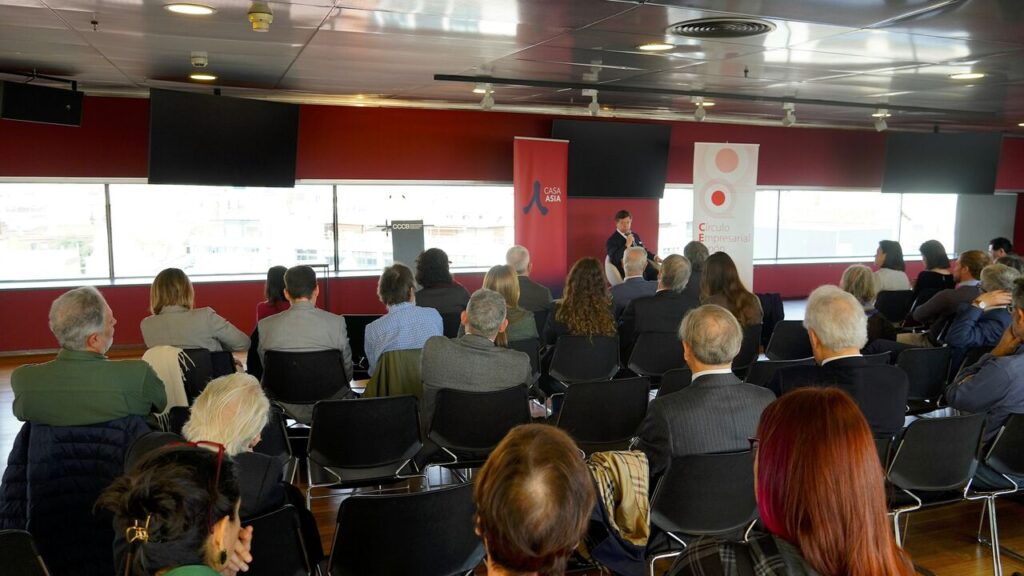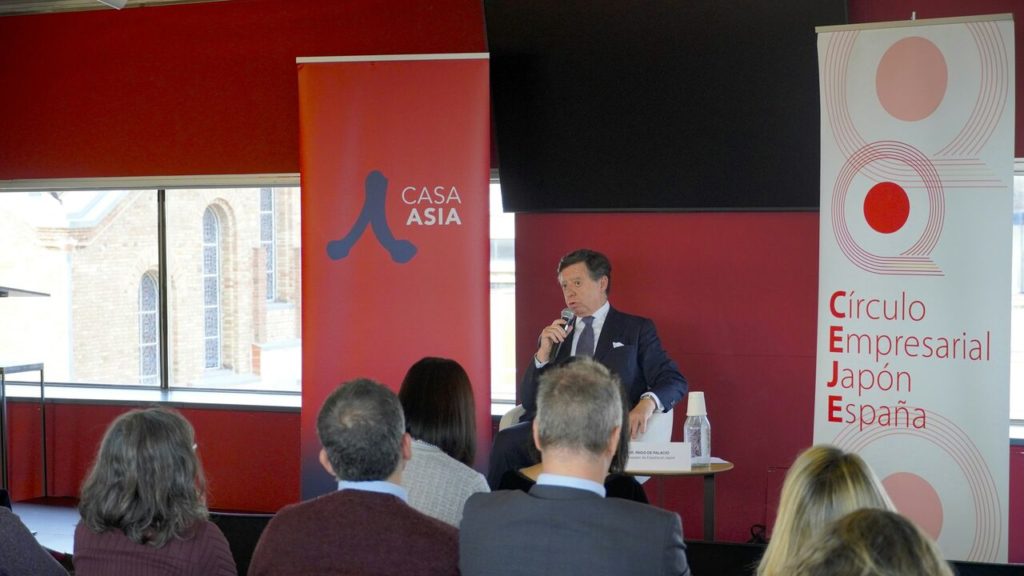
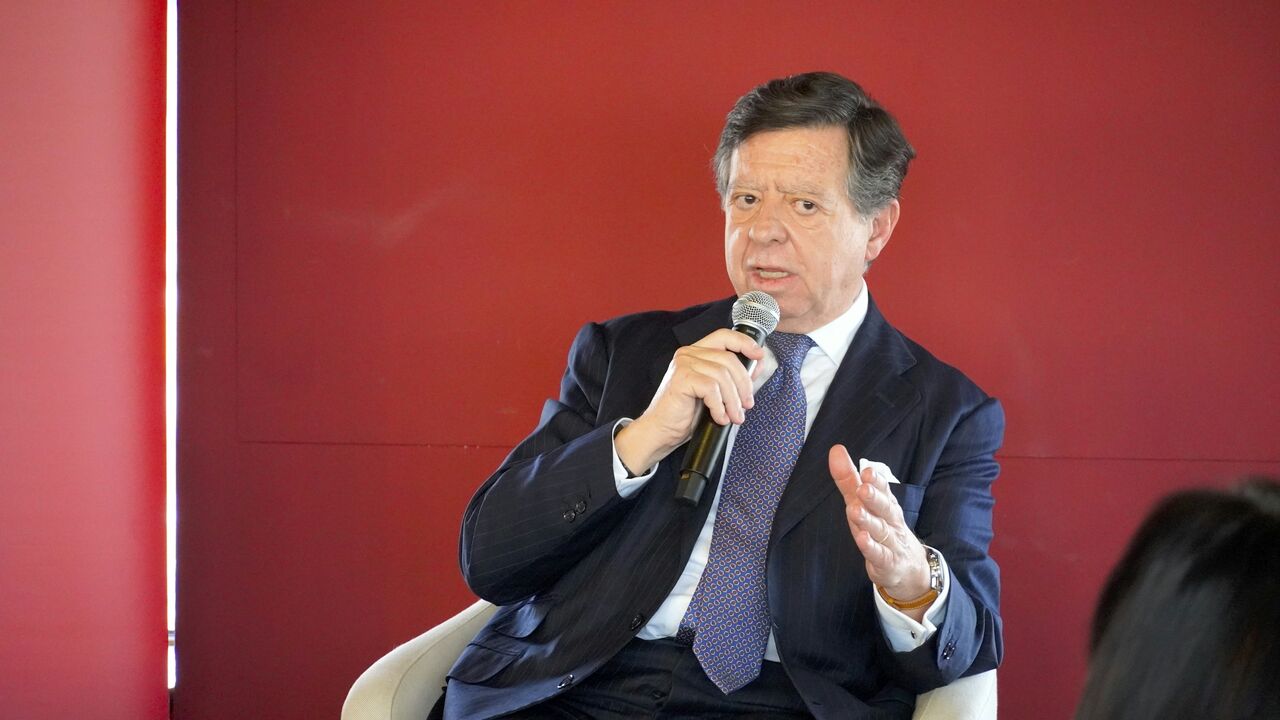
The Spain-Japan Business Circle (CEJE) and Casa Asia held the conference “How geopolitics and innovation are redefining business opportunities in Japan” in Barcelona today, with the participation of the Spanish Ambassador to Japan, Mr. Íñigo de Palacio España, who analyzed the profound change in the cycle that the Asian country is experiencing.
During his speech, the Ambassador stressed that, despite global challenges, Japan maintains a solid and competitive economy. The evolution of the yen has favored exports, and the country’s monetary and fiscal policies seek a balance that strengthens its economy without hindering innovation or business growth.
On the international stage, Japan continues to consolidate strategic alliances. The relationship with the United States is being reviewed constructively to maintain solid historical cooperation, while Spain, as an allied partner, supports Japanese management in the face of tension with China, which has highlighted Japan’s ability to manage geopolitical challenges with balance and diplomacy. In addition, attention to the progressive rapprochement between China and Russia reinforces Japan’s importance as a key player in the stability of the region.
In the economic field, he stressed the weight of Japanese debt. By way of comparison, the annual cost of debt servicing in Spain is around 39 billion euros, while in Japan it exceeds 170 billion, which conditions fiscal and monetary policy. All of this is framed in a global context of greater fragmentation and economic polarization.
In terms of innovation, the Ambassador argued that Japan is not an exhausted economy, but is knowing how to position itself in the intermediate phases of the large value chains, especially in advanced technologies such as semiconductors, where it controls critical components that make its role in global industry indispensable.
Regarding the bilateral relationship, he stressed that Spain has become a strategic partner for Japan in Europe, with a Japanese investment stock of close to 13 billion euros and some 50,000 jobs generated. Within this framework, Catalonia plays a key role. The Ambassador defined it as the main engine of economic relations between Spain and Japan, due to its concentration of Japanese subsidiaries, its innovation ecosystem and its logistical role, with the Port of Barcelona as an essential node towards Asia.
The session concluded with a question and answer session in which topics such as Mercosur, foreign investment in Japan and Japanese immigration policy were discussed, highlighting that Japan is moving towards a gradual and controlled opening to attract qualified talent.
The conference has reaffirmed the role of the CEJE as a reference space to promote mutual understanding and business opportunities between Spain and Japan at a decisive moment for both economies.